CAVE TEAHOUSE & TREE TAVERN
石室茶屋与树洞酒馆
石室茶屋与树洞酒馆
Familiar Novelty | Nostalgic Naivety — Under Fengyuzhu's overall curation, the village has been repositioned as the Ancient Banyan Literary Village. As a node within this larger framework, the project needed to do more than produce an architectural expression; it had to balance curatorial narrative, intensified new programs, and the memory of the site. From the outset, we approached the intervention with caution: the two houses still maintained a quiet relationship with the ancestral hall, and their original character deserved to be preserved. Yet the village fabric had already been fragmented by surrounding new villas, while the old houses themselves could hardly support the incoming programs of a tavern and a tea room.
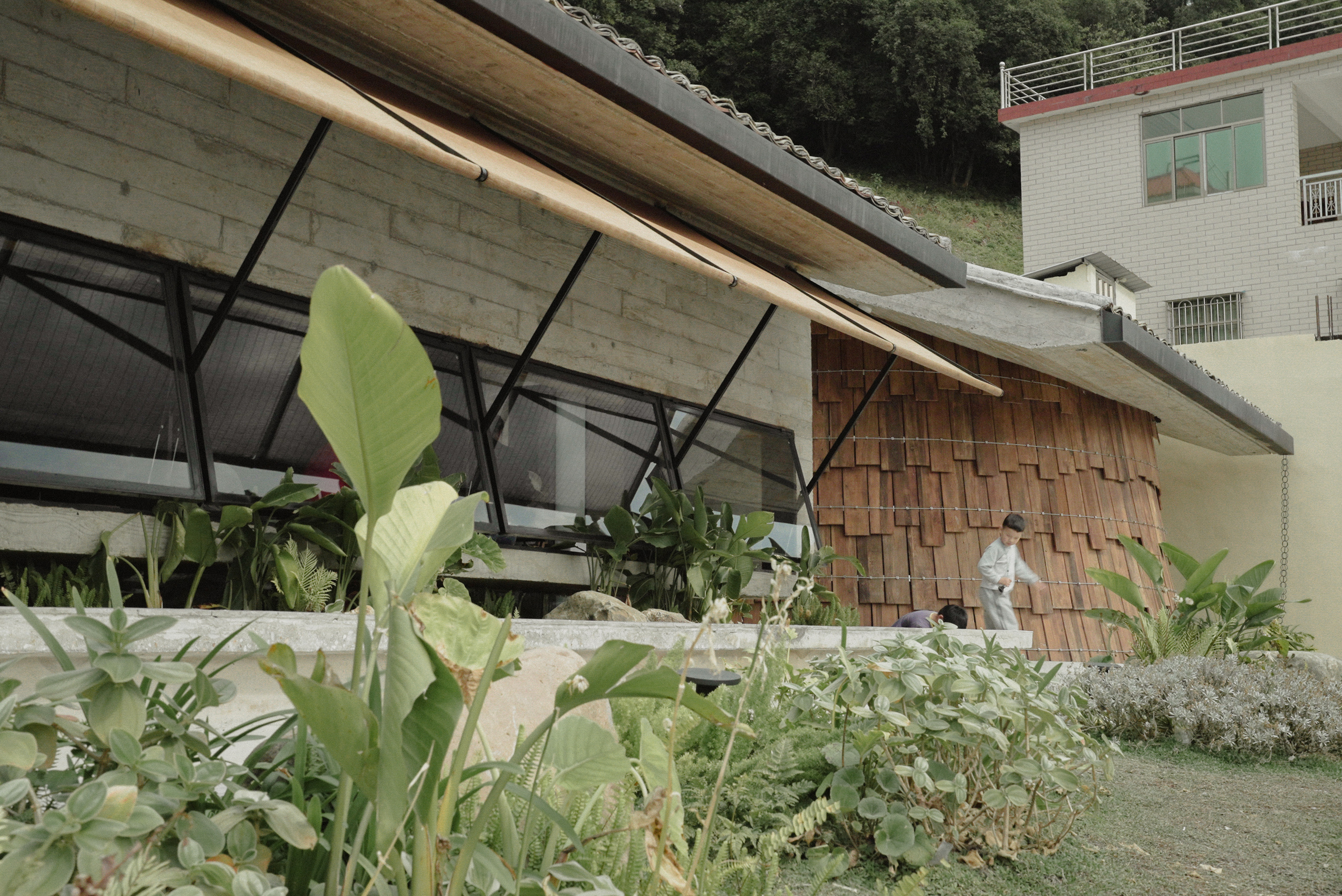
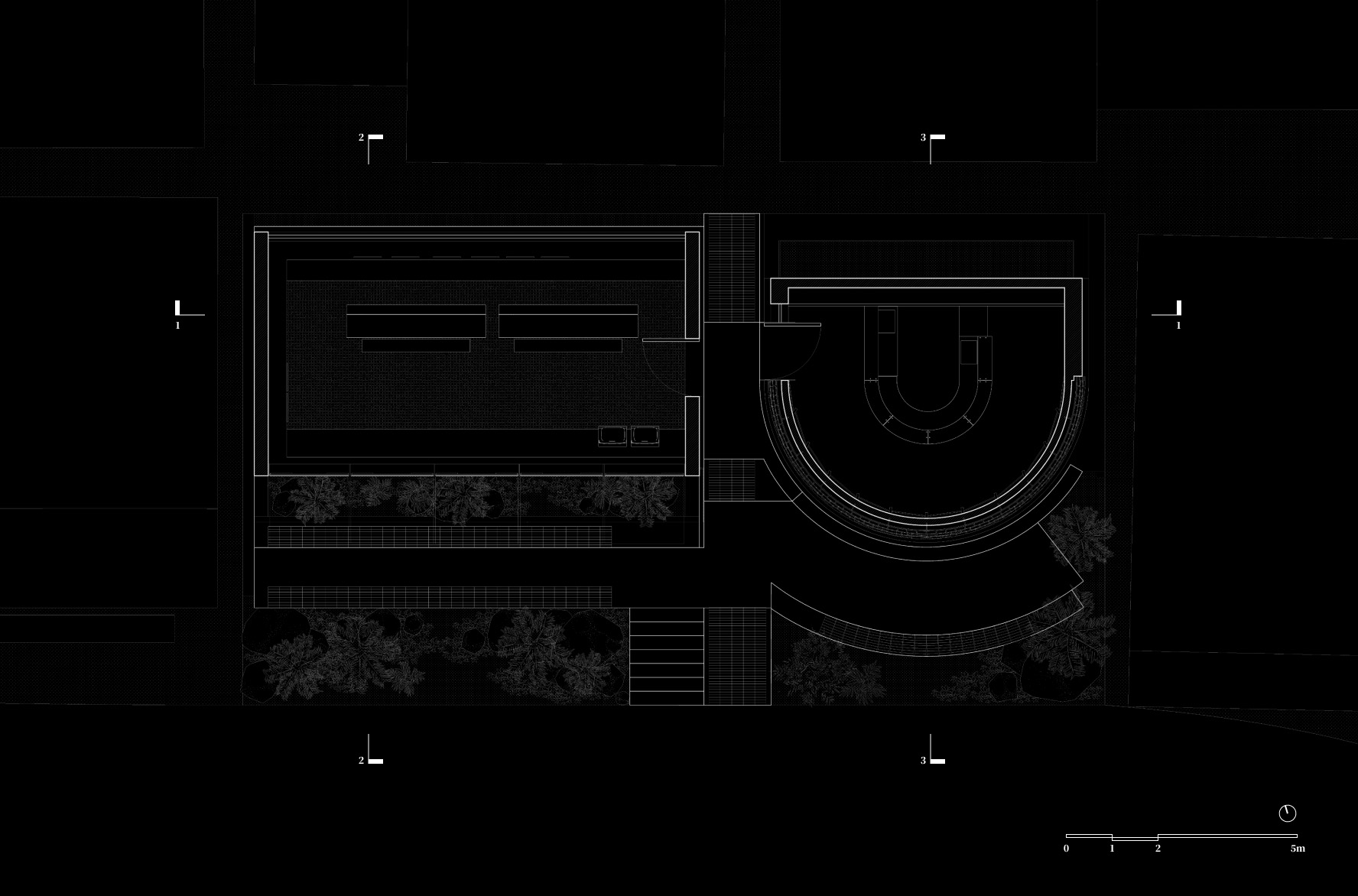
We decided to rethink the spaces of a tavern and a tearoom from within the site itself. The new wood-grained concrete follows the outline of the old houses and reuses their original roof tiles; beige bamboo blinds echo the layered eaves and tones of the nearby ancestral hall; and although the tavern departs from the language of the old dwellings, its reclaimed elm boards come from the countryside. Together, these gestures create a sense of familiar novelty, or perhaps nostalgic naivety, responding to the tension between rural reality and cultural tourism today.
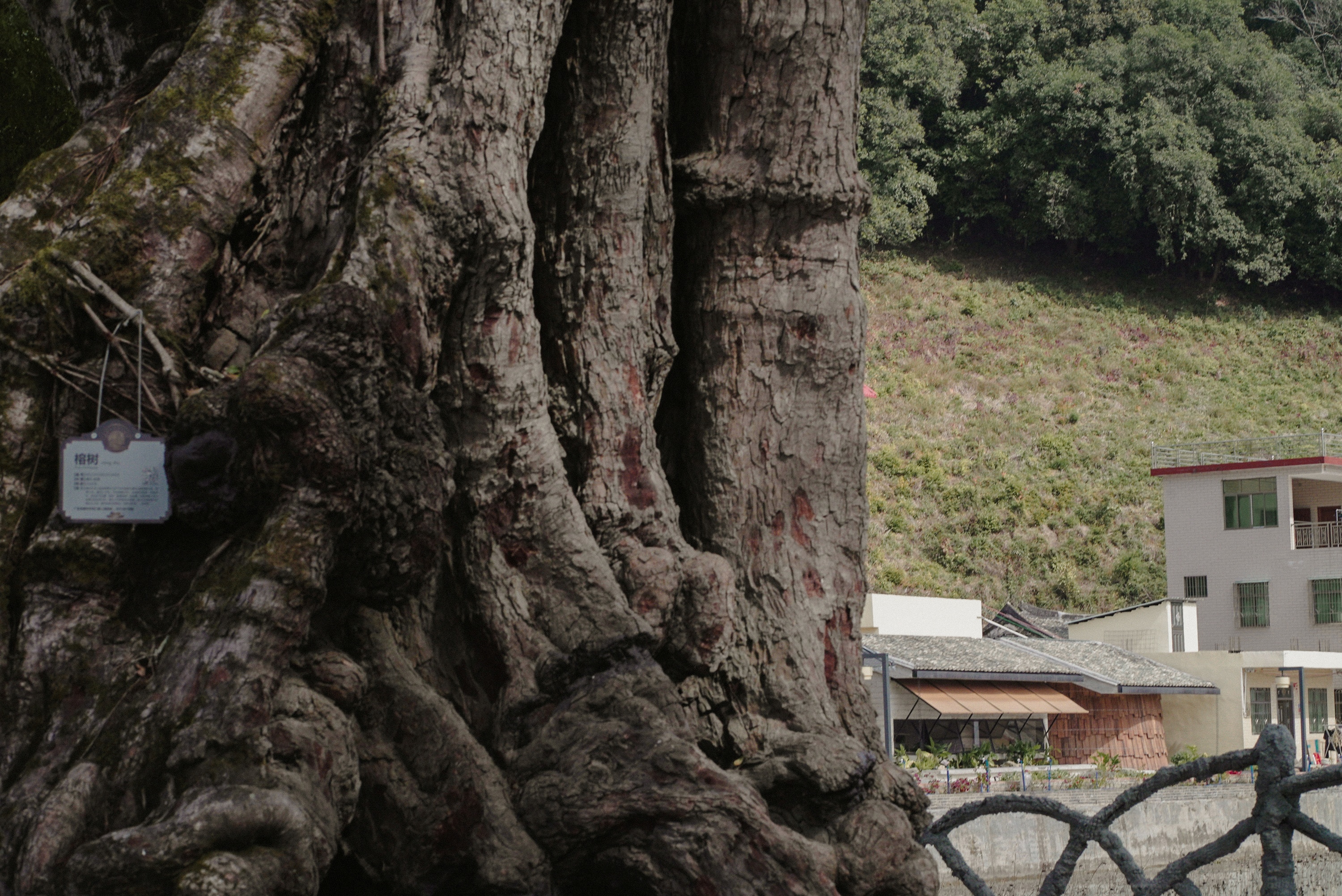
Tree and Tavern — The tavern was the first new program introduced through the renovation, yet for the village it remained a foreign concept without precedent. We responded with a tipsy imagination, borrowing the ancient banyan tree at the village entrance and imagining that one day an old house might grow into its sibling. Hidden inside, quietly, is a place for a drink—perhaps the kind of tavern that could belong to a village of literature.
Some taverns in cities transform into cafés during the day, but we wanted this one to belong to the night alone. The tree thus became the ideal disguise for a tavern that should remain closed by day: a life-like presence, inviting to touch and approachable in a way that could appeal across ages. In the details of the bark, the tectonics of steel wires and metal fastenings used to strap wooden barrels offers a subtle hint of the liquer hidden inside.
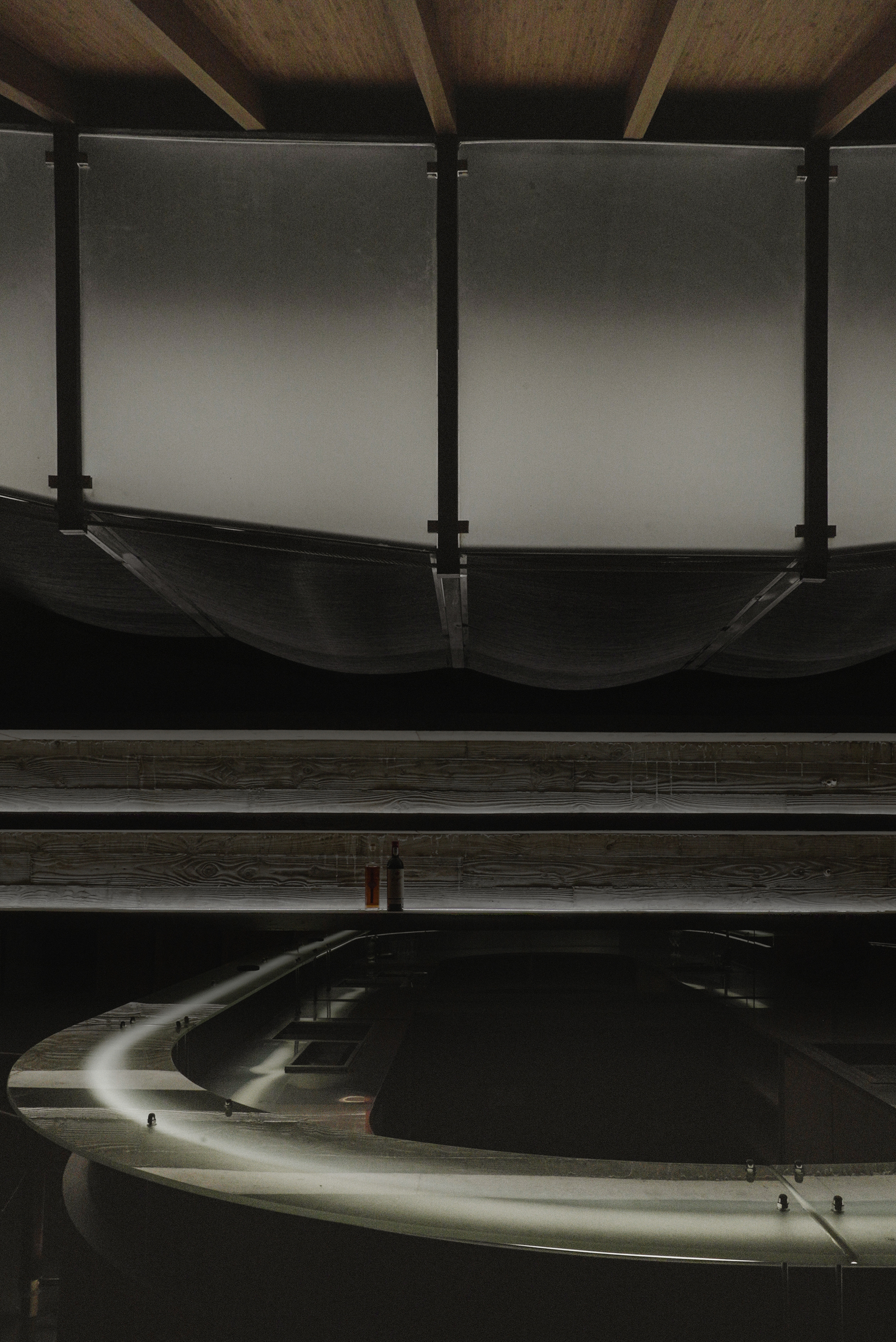
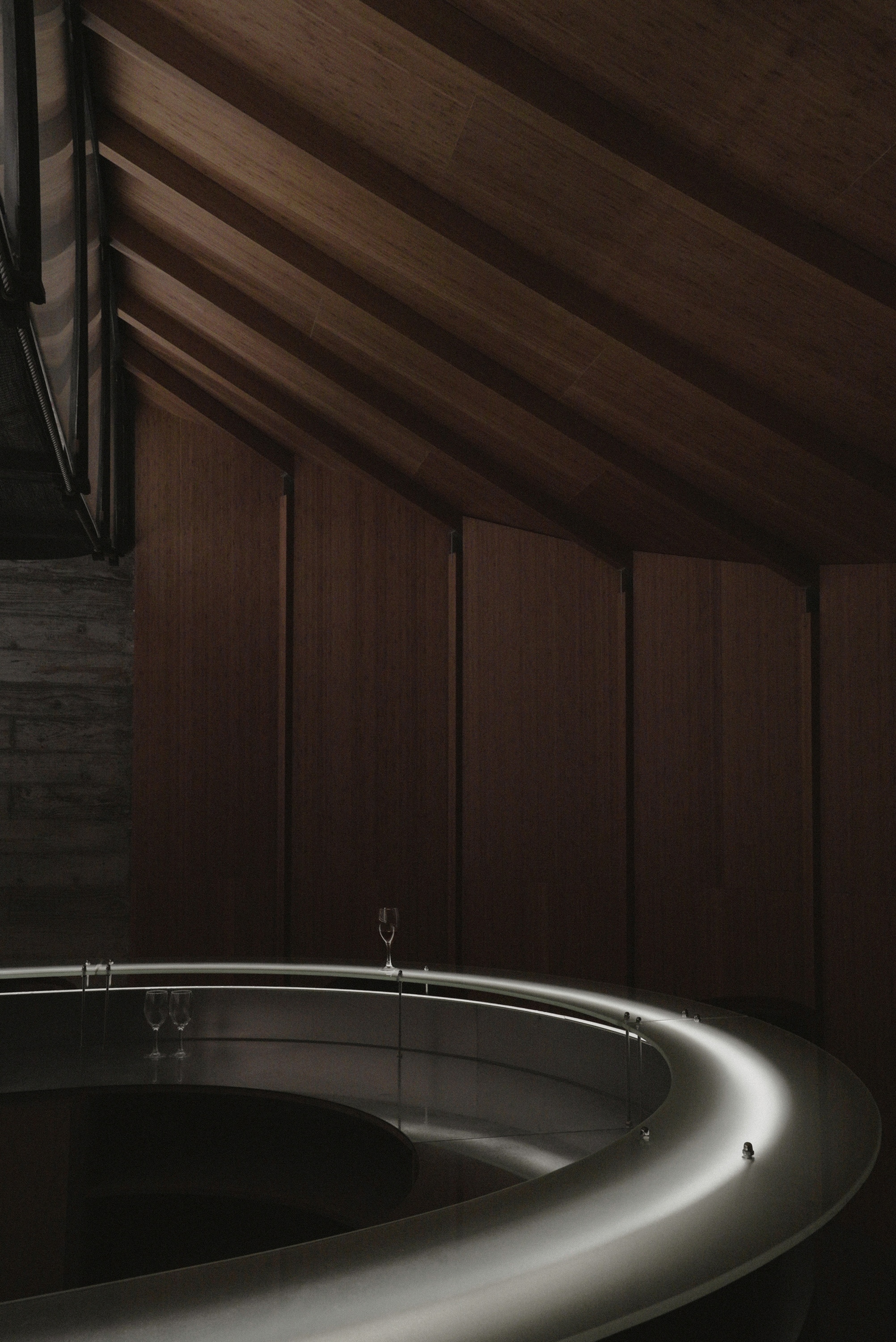
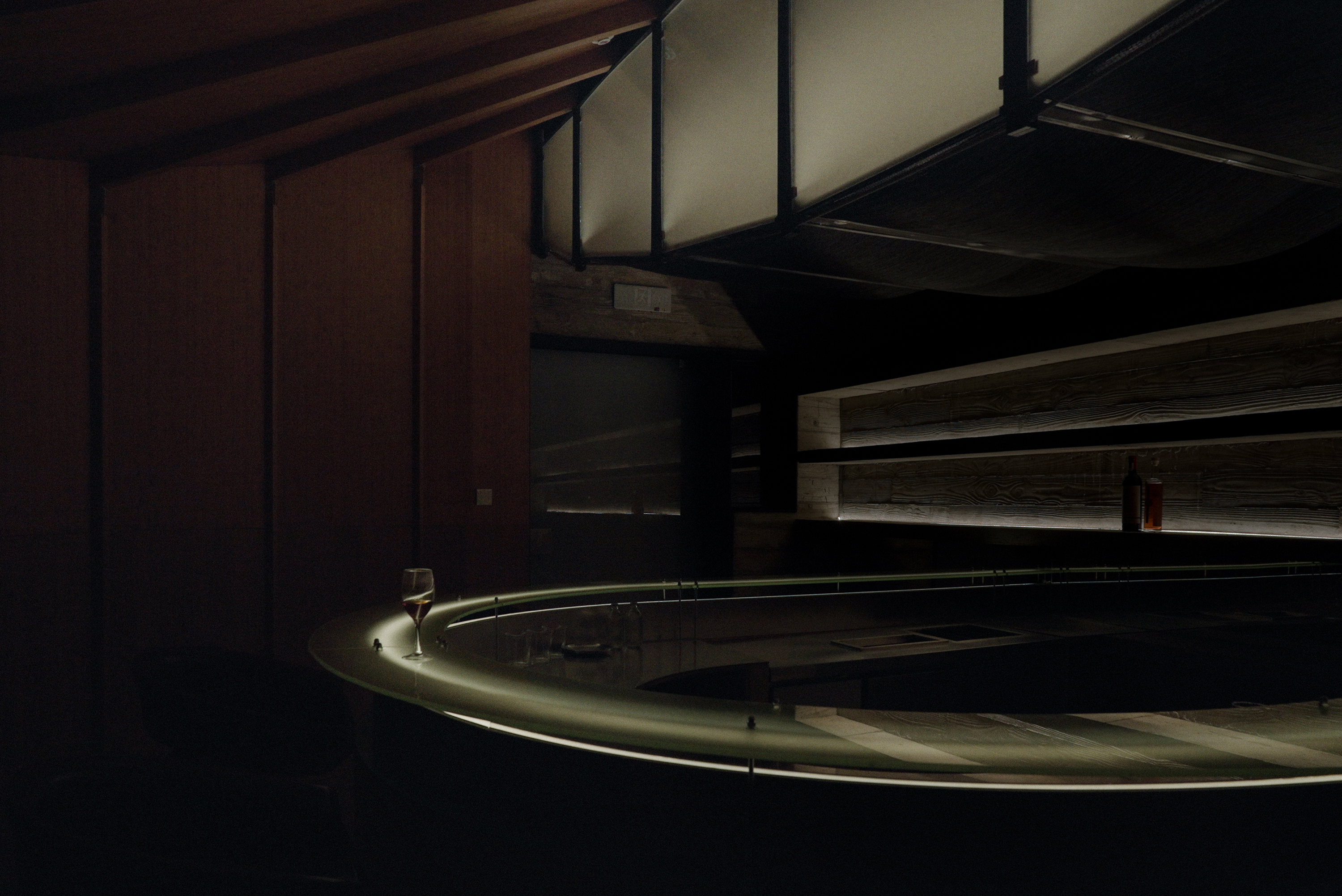
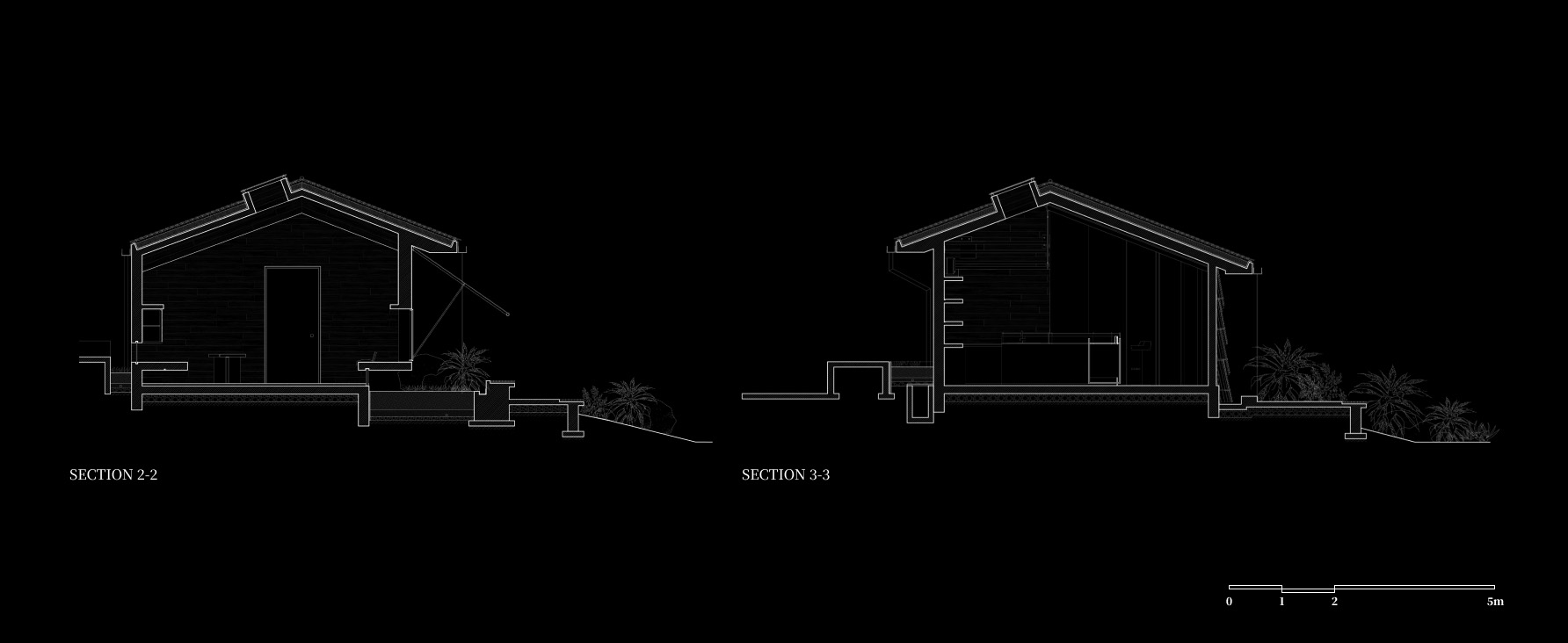
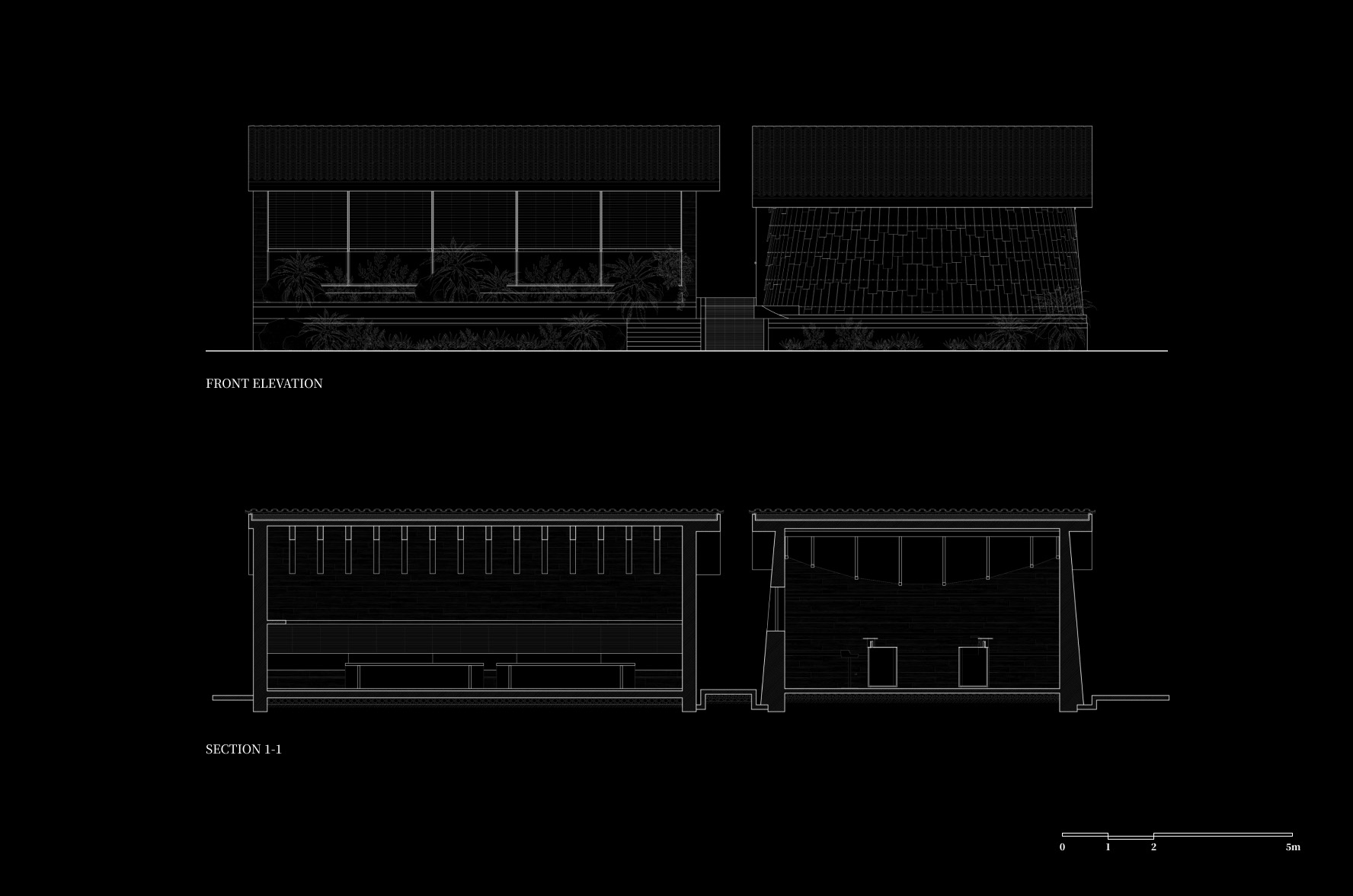
Inside the tree is too small to hold more than a bar. The form follows the logic of structure, as if shaped by growth from within. A large truss holds up the space, accommodates services, and opens as a fissure through which the dominant light enters. From this crack, secondary rafters fans outward, lapping onto slender columns that touch the ground, echoing the veins and fibers of a tree trunk. And the luminous ring above the bar does more than distinguish the drinker from the server; within the mirror of this compact space, it extends into another possible dimension.
Cave and Tea-house — Once the Tree Tavern had taken shape, we learned that the neighboring house would also be renovated into a tea house. The tavern's inward, nocturnal character led us to imagine its new neighbor in contrast: if drinking retreats into the night, tea belongs to daylight, nature, and the garden. We therefore sought to draw light and landscape into the tea-house, while keeping the interior itself plain and restrained. Its close proximity to the ancestral hall also made us especially careful in handling the eaves, tones, and material textures between old and new.
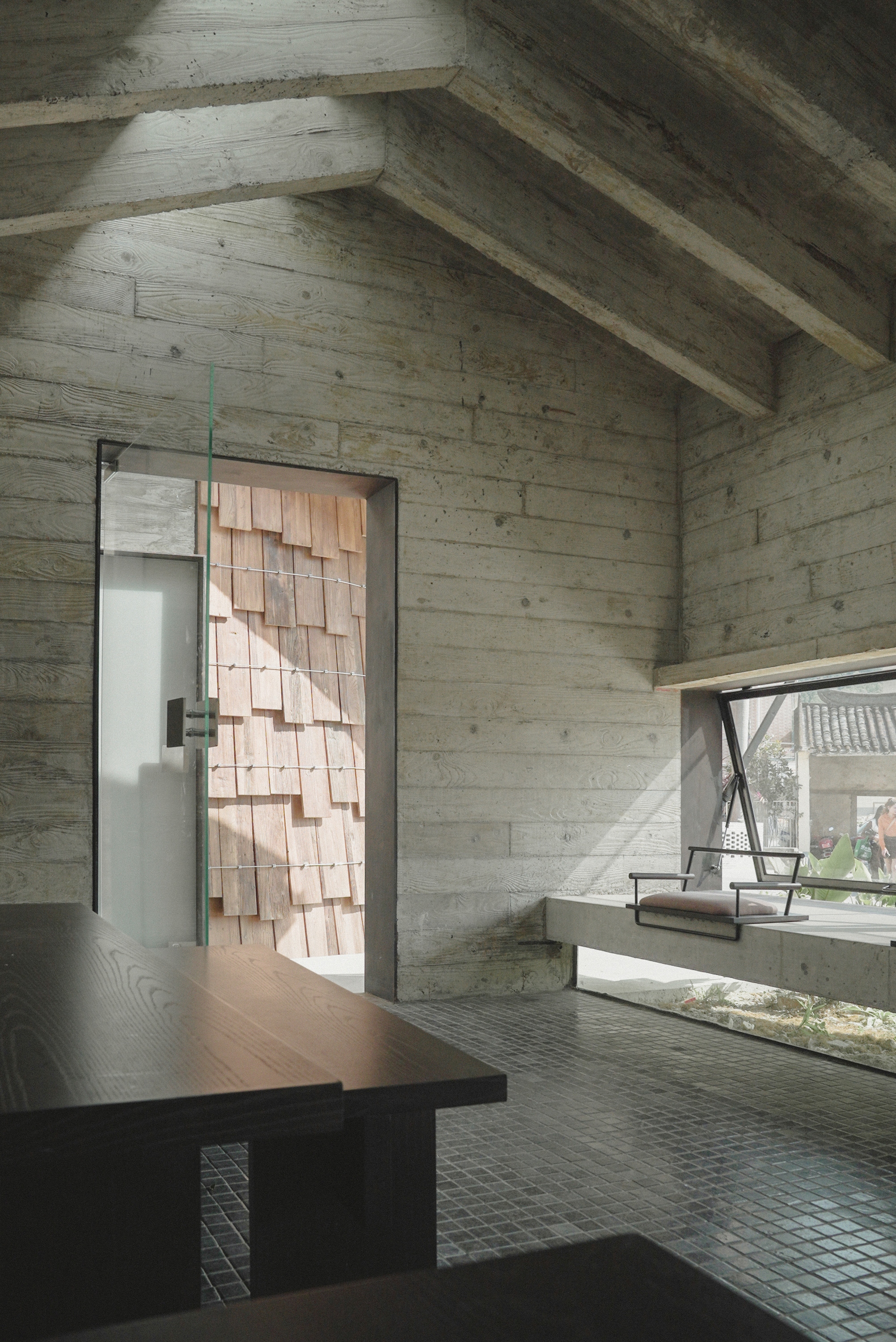
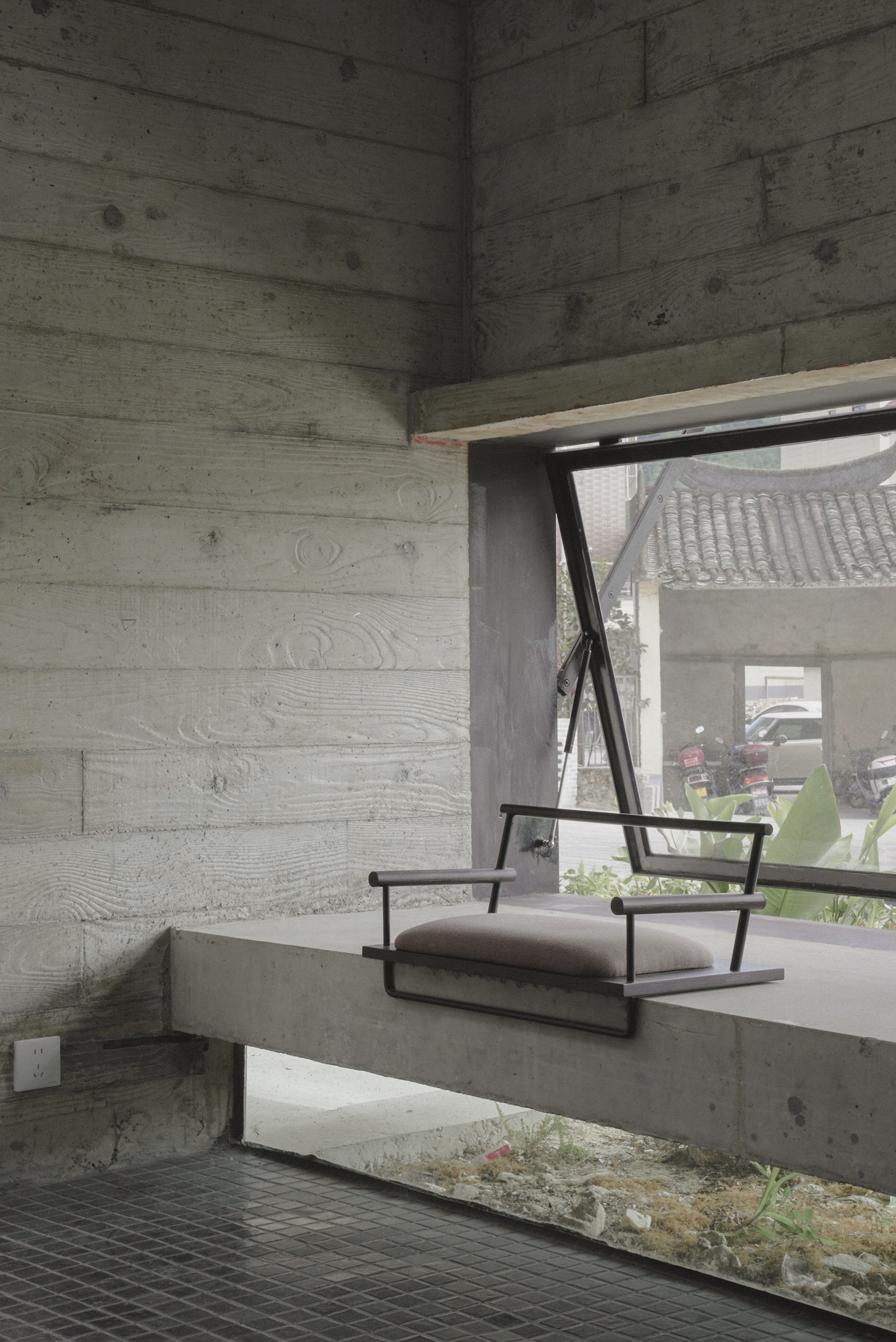
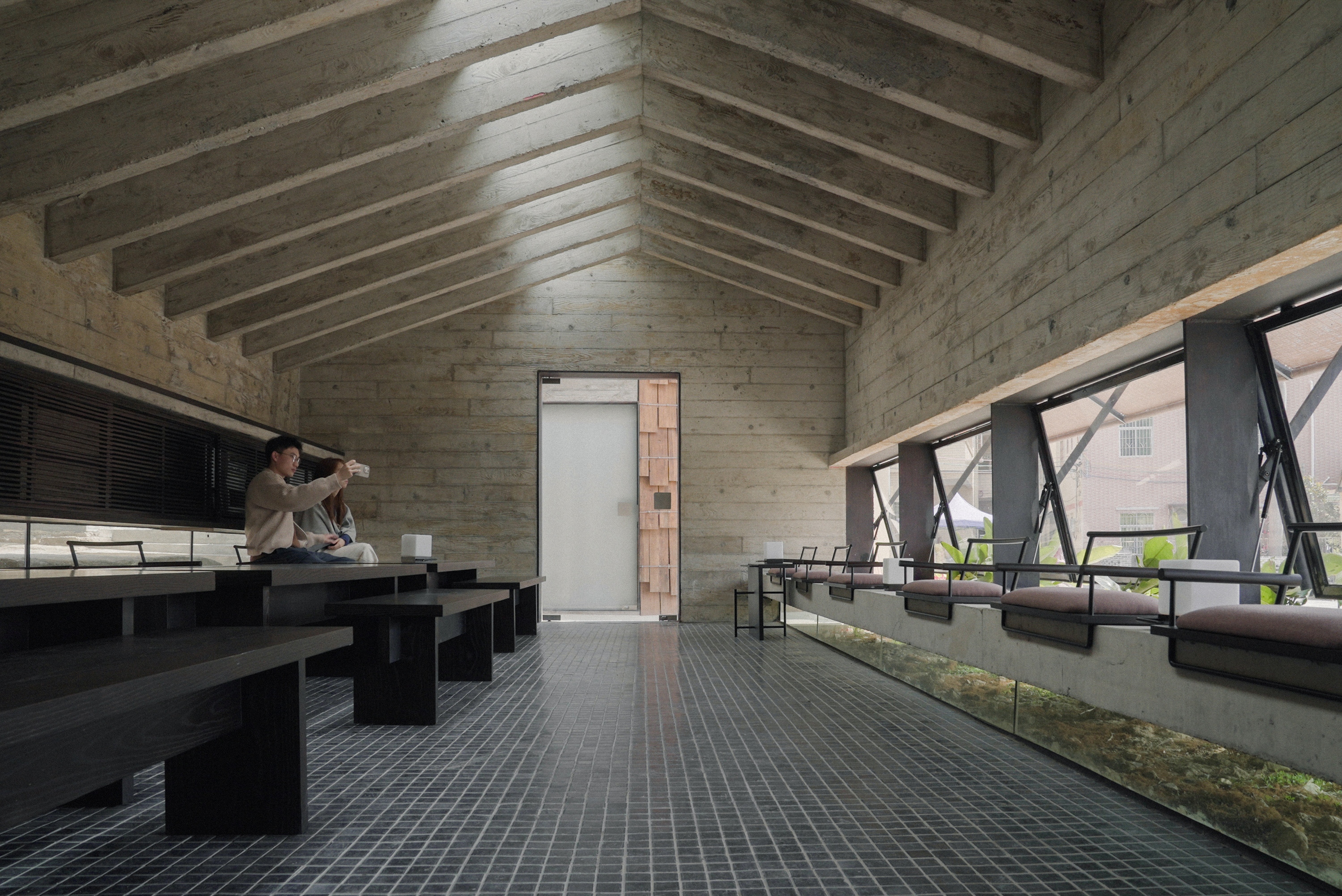
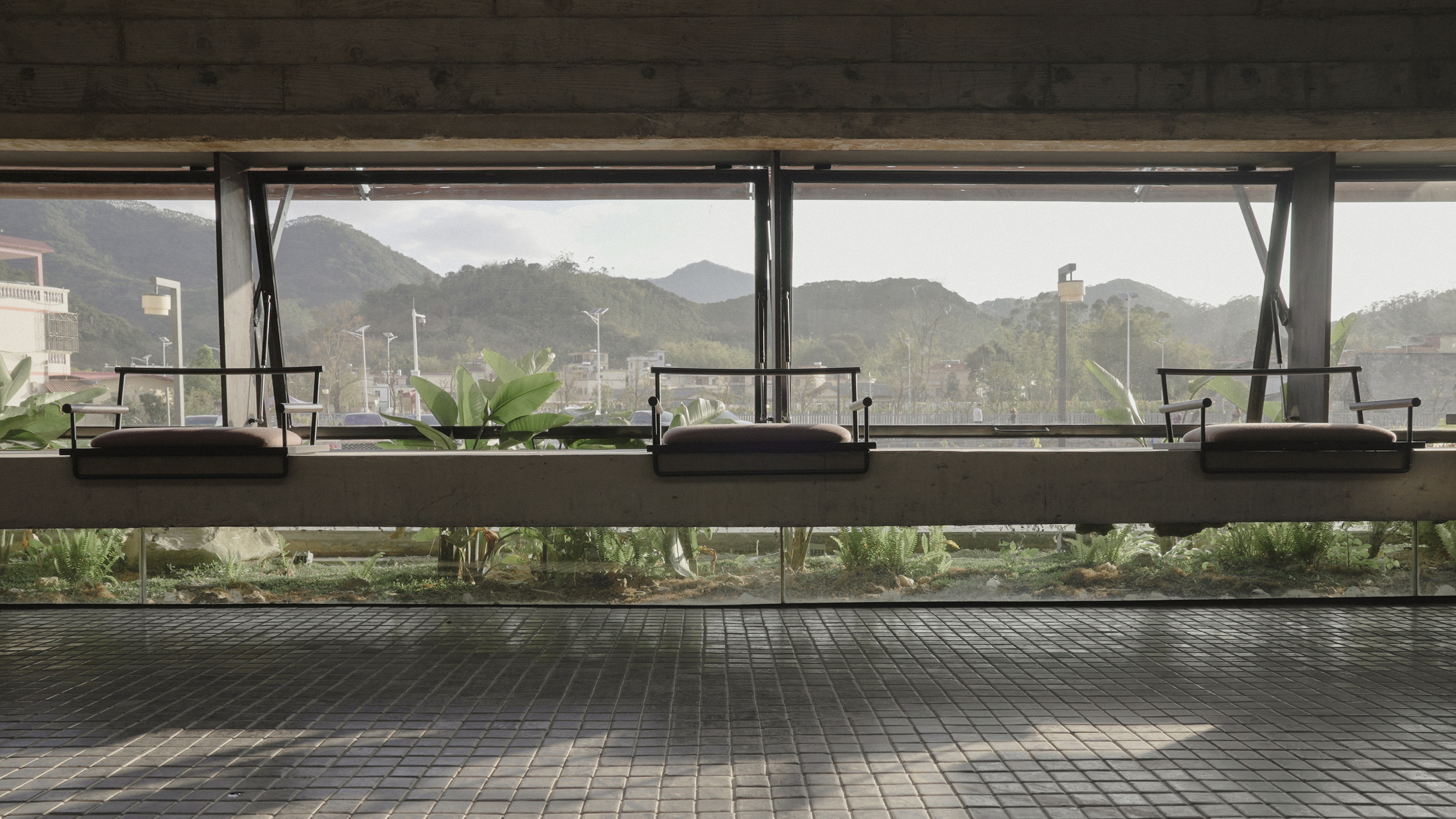
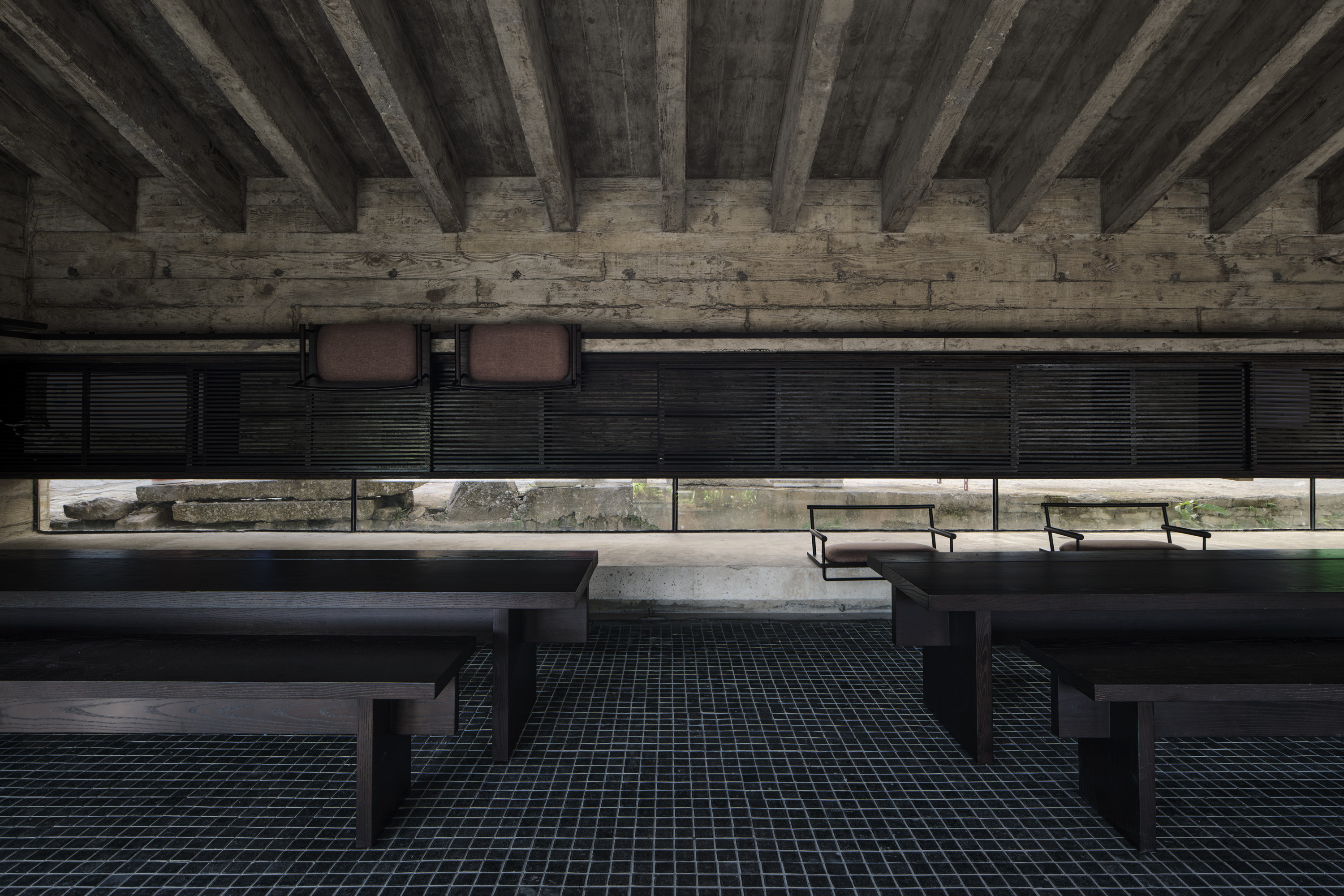
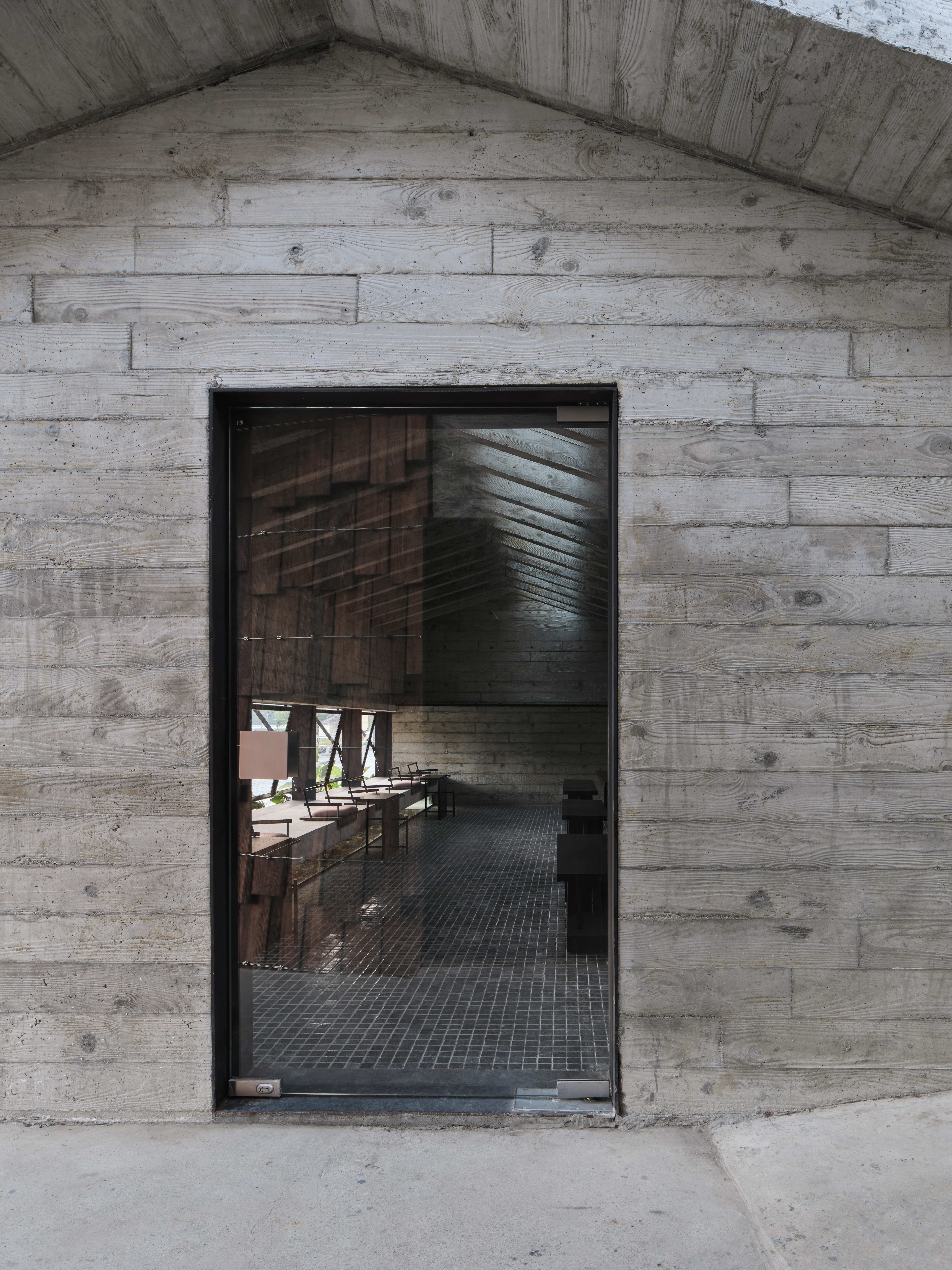
The tea-house was cast monolithically in wood-grain concrete, so that beams, slabs, walls, and openings could read as a continuous whole. A deep beam at the front lowers the horizontal window to match the seated eye level, drawing the greenery and distant hills closer into view. The same beam also suspends the long bench, allowing moss at the ground and floor tiles within to meet seamlessly in a gently overflowing spatial experience. At the rear, a low window frames the neighboring stone terrace, while filtered top light passing through dense beams produces subtle shifts in interior illumination. Each opening was shaped as a specific mediation of light and landscape—less a window than a aperture—which is also why we came to think of the space as a "cave".
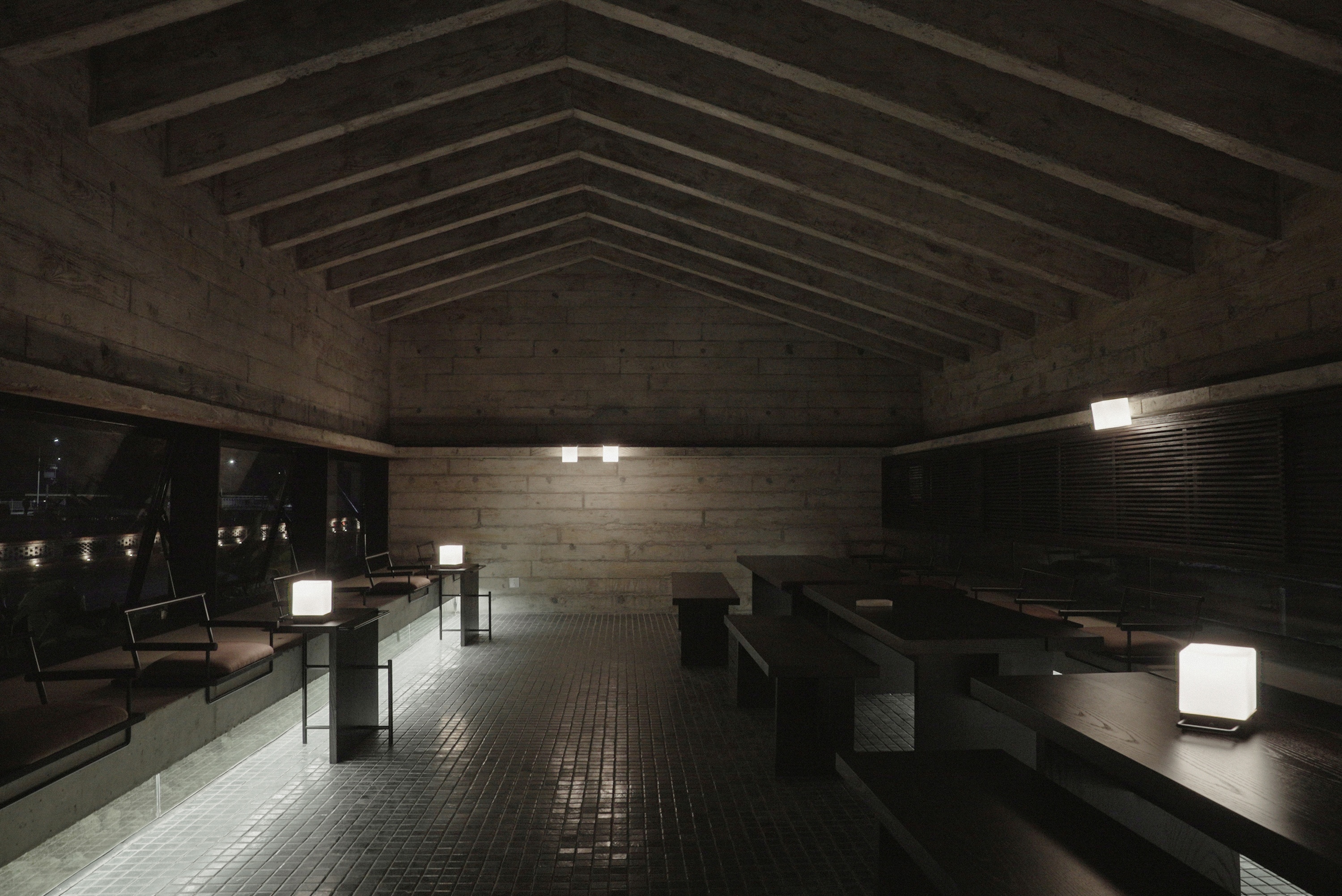
As a cave, it should contain no fixed furniture or lighting. Inspired by the Shakers' historical use of hanging furniture, we designed the chair backs, tea tables, and lamps as movable objects that can be hung on wall-mounted racks, much like tea utensils themselves. Guests must take down those to arrange their own setting for tea, and likewise take the lamps to light the room at night. We wanted the tea-house to return, after each use, to the purified state of a cave—an exercise in self-awareness embedded in the culture of tea. At the same time, the hanging furniture echoes the structural logic of the deep beams and low windows, introducing a quiet tension beyond the everyday within the familiar outline of a village house.
Epilogue: Literature and Architecture — As two nodes within the Literary Village, the tavern and tea house inevitably drew upon a series of literary images and references. For the tavern, we discussed Llosa, Haruki Murakami, Calvino, and Borges; for the tea-house, we reflected on Liu Yuxi, Wen Zhenheng, and Thoreau. While resisting a literal translation of literature into architecture—and the risk of turning rural renewal into a theme-park spectacle—we also embraced the fact that certain architectural experiences can genuinely arise from the quiet inspiration of enduring texts.
What surprised us was the tension we discovered between the tavern and the tea-house: they can be read as two distinct spaces, yet also as a single paired composition. This seemed to touch upon a deeper affinity between literature and architecture. The two spaces differ radically, yet across multiple dimensions—tea and liquer, interior and exterior, square and round, stone and wood, day and night—they articulate and confront one another. Inevitably, this brought to mind the polyphonic juxtapositions often found in Western fiction, as well as the intertextuality common in classical Chinese poetry. This structural poetics exceeds what either space can offer on its own, and belongs equally to literature and to architecture.
在风语筑的整体策划下,项目所在的中心村以“古榕文学村”的定位重新接入了“环两山建筑艺术计划”的文旅版图。“城市策展”在当下已成为一种高效的存量再利用模式,作为其中的一个点位,所需要的远不仅限于建筑的表达,更是平衡于策划的叙事、功能的重载与场地的记忆之间。这些复杂性使得我们在最初介入场地时再三斟酌——需改造的两处房子与祠堂尚且维持着和谐的联系,场地原生的气质值得被保留;但同时,周边新式别墅的林立使得村内的风貌早已芜杂,老民居内的结构与格局也实在难以支撑“酒馆”与“茶室”这两个将被注入的新业态。
在场地中不尽人意的新与难堪整饬的旧之间徘徊许久,我们最终决定从“酒”与“茶”两个关键词重新思考和出发——不破不立,但扎根于场地内,找回能够被感知到的线索:木模混凝土的新浇筑遵循老屋的轮廓,并重铺了原屋面的旧瓦;米色的遮阳竹帘试图衔接一旁祠堂的重檐与色调;酒馆虽跳脱出了原民居的形式语言,但使用的老榆木板却是来自于乡村的二手回收……这些细微的考量都希望在场地上创造了一种“熟悉的新奇”,或说“念旧的天真”,以此回应当下乡村问题与文旅命题之间发生的激撞。
在树洞酒馆的概念基本明确后,我们得知相邻的民居也需被改造,并将注入茶屋的新功能。所以“树”与“酒”成为了“茶屋”所倚傍的语境,也使得我们开始思考这对新邻居之间的关系。若说树洞强化了一个饮酒空间的内向性,使其躲藏在夜晚,而饮茶则恰恰当与日间的自然相伴。因此,我们试图将户外的光与景引入茶屋,而室内本身尽可能地质朴,以求“斯是陋室,惟吾德馨”、“宁古无时,宁朴无巧”的感受,既是石室,亦可是陋室。而茶屋的原状毗邻村中祠堂,也让我们对于檐口、色调、肌理等两者的衔接面更为谨慎。
在结构表达与建造工法上,石室借由木模清水砼一体浇筑,其梁、板、墙、洞求的是一气呵成。前侧的深梁大大压低了横跨的窗洞,意在贴合坐饮时的视线高度,以拉近室外的绿植与远山。而深梁之深足以同时悬吊住了窗前的坐台,使地表的苔藓与地面的贴砖衔接,而有几分“侧坐莓苔草映身”般外溢与流动的体验。后侧的低窗恰可窥见邻居家的石板地台,而顶部的天光在密梁的过滤下对室内做出细微的照度调节——四方开口都出于对户外有限光景的某种处理,似窗口而更似洞口,也是“石室”比喻的另一缘由。
“树”的内部小得将将容得下一圈吧台。我们试图为酒客们创造一个可逃逸的树洞,因此在空间的具象与抽象间平衡,最终选择让其形式遵循结构的逻辑,如树内部的生长:空间由正中的大张弦梁支起,提供了设备空间,更是一道投出主宰光线的裂缝;次一级的椽条则由着这道裂缝放射状散开,搭接落地的细柱,以类比树体的茎络。而吧台上的光环不仅仅划分了饮者与侍者,更在这个方寸间的镜面之中延伸至了另一个可能的时空。
在树洞酒馆的概念基本明确后,我们得知相邻的民居也需被改造,并将注入茶屋的新功能。所以“树”与“酒”成为了“茶屋”所倚傍的语境,也使得我们开始思考这对新邻居之间的关系。若说树洞强化了一个饮酒空间的内向性,使其躲藏在夜晚,而饮茶则恰恰当与日间的自然相伴。因此,我们试图将户外的光与景引入茶屋,而室内本身尽可能地质朴,以求“斯是陋室,惟吾德馨”、“宁古无时,宁朴无巧”的感受,既是石室,亦可是陋室。而茶屋的原状毗邻村中祠堂,也让我们对于檐口、色调、肌理等两者的衔接面更为谨慎。
在结构表达与建造工法上,石室借由木模清水砼一体浇筑,其梁、板、墙、洞求的是一气呵成。前侧的深梁大大压低了横跨的窗洞,意在贴合坐饮时的视线高度,以拉近室外的绿植与远山。而深梁之深足以同时悬吊住了窗前的坐台,使地表的苔藓与地面的贴砖衔接,而有几分“侧坐莓苔草映身”般外溢与流动的体验。后侧的低窗恰可窥见邻居家的石板地台,而顶部的天光在密梁的过滤下对室内做出细微的照度调节——四方开口都出于对户外有限光景的某种处理,似窗口而更似洞口,也是“石室”比喻的另一缘由。
既是石室,可能也无需固定的家私与照明。所谓“羚羊挂角,无迹可寻”,我们将座椅靠背、茶几与灯盏统统设计为可灵活悬挂于墙架的器物,与茶具一般——茶客需亲自取下茶座与茶几以布置品饮的席位,也需亲自取下灯具,以照亮夜间的室内。我们希望茶屋在每次使用的始末,都将被归零到如石室般极致的洗炼,这是对饮茶文化中自我观照的一种练习;而另一方面,活动家具的悬挂亦呼应了“重梁低窗”的结构,在寻常民居的轮廓中置入一种超出日常的戏剧性。
作为“文学村”中的两处点位,酒馆与茶屋在创作过程中不可避免地涉及到一系列文学意向,或也可说是典故。我们在“树洞酒馆”中探讨过略萨、村上春树、卡尔维诺与博尔赫斯,也在“石室茶屋”中思考过刘禹锡、文震亨与梭罗。一方面,我们似乎在试图抵抗建筑创作陷入直白的转译,使乡村焕新走向主题乐园式的过犹不及,可另一方面也需欣然承认,一些建筑体验可以是真实地来源于隽永文字的启迪。
让我们比较惊喜的是,创作过程中发现酒馆与茶屋即可分二、又可合一的张力,似乎触及到了文学与建筑某些深层的共通之处。这两处空间大相径庭,却又在茶与酒、内与外、方与圆、石与木、日与夜等各维度上相互表达、对峙、印证与补充,和而不同,不禁让我们联想到西方小说中常出现的复调式并置,以及我国古典诗歌中常有的互文——这种结构性的诗意超越了两侧主体本身所能提供的体验,且文学与建筑共有之。
We decided to rethink the spaces of a tavern and a tearoom from within the site itself. The new wood-grained concrete follows the outline of the old houses and reuses their original roof tiles; beige bamboo blinds echo the layered eaves and tones of the nearby ancestral hall; and although the tavern departs from the language of the old dwellings, its reclaimed elm boards come from the countryside. Together, these gestures create a sense of familiar novelty, or perhaps nostalgic naivety, responding to the tension between rural reality and cultural tourism today.
Tree and Tavern — The tavern was the first new program introduced through the renovation, yet for the village it remained a foreign concept without precedent. We responded with a tipsy imagination, borrowing the ancient banyan tree at the village entrance and imagining that one day an old house might grow into its sibling. Hidden inside, quietly, is a place for a drink—perhaps the kind of tavern that could belong to a village of literature.
Some taverns in cities transform into cafés during the day, but we wanted this one to belong to the night alone. The tree thus became the ideal disguise for a tavern that should remain closed by day: a life-like presence, inviting to touch and approachable in a way that could appeal across ages. In the details of the bark, the tectonics of steel wires and metal fastenings used to strap wooden barrels offers a subtle hint of the liquer hidden inside.
Inside the tree is too small to hold more than a bar. The form follows the logic of structure, as if shaped by growth from within. A large truss holds up the space, accommodates services, and opens as a fissure through which the dominant light enters. From this crack, secondary rafters fans outward, lapping onto slender columns that touch the ground, echoing the veins and fibers of a tree trunk. And the luminous ring above the bar does more than distinguish the drinker from the server; within the mirror of this compact space, it extends into another possible dimension.
Cave and Tea-house — Once the Tree Tavern had taken shape, we learned that the neighboring house would also be renovated into a tea house. The tavern's inward, nocturnal character led us to imagine its new neighbor in contrast: if drinking retreats into the night, tea belongs to daylight, nature, and the garden. We therefore sought to draw light and landscape into the tea-house, while keeping the interior itself plain and restrained. Its close proximity to the ancestral hall also made us especially careful in handling the eaves, tones, and material textures between old and new.
The tea-house was cast monolithically in wood-grain concrete, so that beams, slabs, walls, and openings could read as a continuous whole. A deep beam at the front lowers the horizontal window to match the seated eye level, drawing the greenery and distant hills closer into view. The same beam also suspends the long bench, allowing moss at the ground and floor tiles within to meet seamlessly in a gently overflowing spatial experience. At the rear, a low window frames the neighboring stone terrace, while filtered top light passing through dense beams produces subtle shifts in interior illumination. Each opening was shaped as a specific mediation of light and landscape—less a window than a aperture—which is also why we came to think of the space as a "cave".
As a cave, it should contain no fixed furniture or lighting. Inspired by the Shakers' historical use of hanging furniture, we designed the chair backs, tea tables, and lamps as movable objects that can be hung on wall-mounted racks, much like tea utensils themselves. Guests must take down those to arrange their own setting for tea, and likewise take the lamps to light the room at night. We wanted the tea-house to return, after each use, to the purified state of a cave—an exercise in self-awareness embedded in the culture of tea. At the same time, the hanging furniture echoes the structural logic of the deep beams and low windows, introducing a quiet tension beyond the everyday within the familiar outline of a village house.
Epilogue: Literature and Architecture — As two nodes within the Literary Village, the tavern and tea house inevitably drew upon a series of literary images and references. For the tavern, we discussed Llosa, Haruki Murakami, Calvino, and Borges; for the tea-house, we reflected on Liu Yuxi, Wen Zhenheng, and Thoreau. While resisting a literal translation of literature into architecture—and the risk of turning rural renewal into a theme-park spectacle—we also embraced the fact that certain architectural experiences can genuinely arise from the quiet inspiration of enduring texts.
What surprised us was the tension we discovered between the tavern and the tea-house: they can be read as two distinct spaces, yet also as a single paired composition. This seemed to touch upon a deeper affinity between literature and architecture. The two spaces differ radically, yet across multiple dimensions—tea and liquer, interior and exterior, square and round, stone and wood, day and night—they articulate and confront one another. Inevitably, this brought to mind the polyphonic juxtapositions often found in Western fiction, as well as the intertextuality common in classical Chinese poetry. This structural poetics exceeds what either space can offer on its own, and belongs equally to literature and to architecture.
在风语筑的整体策划下,项目所在的中心村以“古榕文学村”的定位重新接入了“环两山建筑艺术计划”的文旅版图。“城市策展”在当下已成为一种高效的存量再利用模式,作为其中的一个点位,所需要的远不仅限于建筑的表达,更是平衡于策划的叙事、功能的重载与场地的记忆之间。这些复杂性使得我们在最初介入场地时再三斟酌——需改造的两处房子与祠堂尚且维持着和谐的联系,场地原生的气质值得被保留;但同时,周边新式别墅的林立使得村内的风貌早已芜杂,老民居内的结构与格局也实在难以支撑“酒馆”与“茶室”这两个将被注入的新业态。
在场地中不尽人意的新与难堪整饬的旧之间徘徊许久,我们最终决定从“酒”与“茶”两个关键词重新思考和出发——不破不立,但扎根于场地内,找回能够被感知到的线索:木模混凝土的新浇筑遵循老屋的轮廓,并重铺了原屋面的旧瓦;米色的遮阳竹帘试图衔接一旁祠堂的重檐与色调;酒馆虽跳脱出了原民居的形式语言,但使用的老榆木板却是来自于乡村的二手回收……这些细微的考量都希望在场地上创造了一种“熟悉的新奇”,或说“念旧的天真”,以此回应当下乡村问题与文旅命题之间发生的激撞。
在树洞酒馆的概念基本明确后,我们得知相邻的民居也需被改造,并将注入茶屋的新功能。所以“树”与“酒”成为了“茶屋”所倚傍的语境,也使得我们开始思考这对新邻居之间的关系。若说树洞强化了一个饮酒空间的内向性,使其躲藏在夜晚,而饮茶则恰恰当与日间的自然相伴。因此,我们试图将户外的光与景引入茶屋,而室内本身尽可能地质朴,以求“斯是陋室,惟吾德馨”、“宁古无时,宁朴无巧”的感受,既是石室,亦可是陋室。而茶屋的原状毗邻村中祠堂,也让我们对于檐口、色调、肌理等两者的衔接面更为谨慎。
在结构表达与建造工法上,石室借由木模清水砼一体浇筑,其梁、板、墙、洞求的是一气呵成。前侧的深梁大大压低了横跨的窗洞,意在贴合坐饮时的视线高度,以拉近室外的绿植与远山。而深梁之深足以同时悬吊住了窗前的坐台,使地表的苔藓与地面的贴砖衔接,而有几分“侧坐莓苔草映身”般外溢与流动的体验。后侧的低窗恰可窥见邻居家的石板地台,而顶部的天光在密梁的过滤下对室内做出细微的照度调节——四方开口都出于对户外有限光景的某种处理,似窗口而更似洞口,也是“石室”比喻的另一缘由。
“树”的内部小得将将容得下一圈吧台。我们试图为酒客们创造一个可逃逸的树洞,因此在空间的具象与抽象间平衡,最终选择让其形式遵循结构的逻辑,如树内部的生长:空间由正中的大张弦梁支起,提供了设备空间,更是一道投出主宰光线的裂缝;次一级的椽条则由着这道裂缝放射状散开,搭接落地的细柱,以类比树体的茎络。而吧台上的光环不仅仅划分了饮者与侍者,更在这个方寸间的镜面之中延伸至了另一个可能的时空。
在树洞酒馆的概念基本明确后,我们得知相邻的民居也需被改造,并将注入茶屋的新功能。所以“树”与“酒”成为了“茶屋”所倚傍的语境,也使得我们开始思考这对新邻居之间的关系。若说树洞强化了一个饮酒空间的内向性,使其躲藏在夜晚,而饮茶则恰恰当与日间的自然相伴。因此,我们试图将户外的光与景引入茶屋,而室内本身尽可能地质朴,以求“斯是陋室,惟吾德馨”、“宁古无时,宁朴无巧”的感受,既是石室,亦可是陋室。而茶屋的原状毗邻村中祠堂,也让我们对于檐口、色调、肌理等两者的衔接面更为谨慎。
在结构表达与建造工法上,石室借由木模清水砼一体浇筑,其梁、板、墙、洞求的是一气呵成。前侧的深梁大大压低了横跨的窗洞,意在贴合坐饮时的视线高度,以拉近室外的绿植与远山。而深梁之深足以同时悬吊住了窗前的坐台,使地表的苔藓与地面的贴砖衔接,而有几分“侧坐莓苔草映身”般外溢与流动的体验。后侧的低窗恰可窥见邻居家的石板地台,而顶部的天光在密梁的过滤下对室内做出细微的照度调节——四方开口都出于对户外有限光景的某种处理,似窗口而更似洞口,也是“石室”比喻的另一缘由。
既是石室,可能也无需固定的家私与照明。所谓“羚羊挂角,无迹可寻”,我们将座椅靠背、茶几与灯盏统统设计为可灵活悬挂于墙架的器物,与茶具一般——茶客需亲自取下茶座与茶几以布置品饮的席位,也需亲自取下灯具,以照亮夜间的室内。我们希望茶屋在每次使用的始末,都将被归零到如石室般极致的洗炼,这是对饮茶文化中自我观照的一种练习;而另一方面,活动家具的悬挂亦呼应了“重梁低窗”的结构,在寻常民居的轮廓中置入一种超出日常的戏剧性。
作为“文学村”中的两处点位,酒馆与茶屋在创作过程中不可避免地涉及到一系列文学意向,或也可说是典故。我们在“树洞酒馆”中探讨过略萨、村上春树、卡尔维诺与博尔赫斯,也在“石室茶屋”中思考过刘禹锡、文震亨与梭罗。一方面,我们似乎在试图抵抗建筑创作陷入直白的转译,使乡村焕新走向主题乐园式的过犹不及,可另一方面也需欣然承认,一些建筑体验可以是真实地来源于隽永文字的启迪。
让我们比较惊喜的是,创作过程中发现酒馆与茶屋即可分二、又可合一的张力,似乎触及到了文学与建筑某些深层的共通之处。这两处空间大相径庭,却又在茶与酒、内与外、方与圆、石与木、日与夜等各维度上相互表达、对峙、印证与补充,和而不同,不禁让我们联想到西方小说中常出现的复调式并置,以及我国古典诗歌中常有的互文——这种结构性的诗意超越了两侧主体本身所能提供的体验,且文学与建筑共有之。
Location: Huizhou, Guangdong, China
地理位置:中国广东省惠州市
Status: Built
项目状态:建成
Duration: 2025
项目周期:2025
Partner Architect: Practice on Earth
合作方:猜一建筑
Team: Zi Meng, Yinuo Qiu, Hanrui Jiang, Guanming Huang, Yifei Feng, Jialin Dai
团队:孟子,邱一诺,姜罕蕊,黄冠铭,冯奕斐,戴家琳
Photographer: Daisy Zhang, Qingyan Zhu
摄影:张子彦、朱清言
地理位置:中国广东省惠州市
Status: Built
项目状态:建成
Duration: 2025
项目周期:2025
Partner Architect: Practice on Earth
合作方:猜一建筑
Team: Zi Meng, Yinuo Qiu, Hanrui Jiang, Guanming Huang, Yifei Feng, Jialin Dai
团队:孟子,邱一诺,姜罕蕊,黄冠铭,冯奕斐,戴家琳
Photographer: Daisy Zhang, Qingyan Zhu
摄影:张子彦、朱清言